Friday, August 13, 2010

Muscovite Artillery


I finally got some artillery painted up for my Muscovite army. Two guns, ready to go!

Hopefully I will be putting the finishing touches to the army this weekend, just in time to take it to the Wells County Collector's Show Monday afternoon (at Bluffton-Harrison Elementary School on Spring Street. Open to the public from 5:30 p.m. until "a little after 8 p.m." if you can/want to go!)

Monday, August 2, 2010

Muscovite Streltsi


I posted an initial photo of theese a few months back, and have been busy painting more over the past few weeks/months. They are the backbone of the Musscovite army that I will be displaying at the Wells County Historical Society's Collectors Show at Bluffton Elementary School on Aug. 16.

The Grand Duchy of Muscovy was essentially the earliest form of what became the Russian "Empire". Prior to the Mongol invasion, the Rus lived in various small independent city states, although Kiev and Novgorod did emerge as slightly more powerful domains than most. Novgorod maintained its prominence through the period of the Mongol "occupation", but as the Mongol empire declined, Muscovy became a center of power.

Initially, the Muscovites were essentially a cavalry army, entirely mounted on horseback, as they had learned from the Mongols. The arrival of gunpowder, and muskets on the battlefield however, created the need for foot soldiers once again - muskets were difficult to manage on horseback.

Thus, regiments of "streltsi" began to appear in Muscovite armies, each in their own brightly colored uniforms. (My army will have four by Aug. 16 - just finishing the fourth now and hopefully will have all four ready for photography by the weekend.)

The Rus (including the Muscovites) still looked to Asia for their inspiration, and the streltsi were "inspired" by the Janissaries of the Turks - armed and organized in a very similar fashion. Their main weapons were the musket and the bardiche - a large battle axe which could be used as either a prop for the musket or as a battle-axe in combat - photos showing both are above.

Initially, the streltsi performed very well. As the years ticked by however, their commanders acquired political power and the body as a whole became conservative to the point of being lazy and backward. When Peter I ("The Great") assumed the throne of Russia in the early 1700s, one of his first jobs became the elimination of the streltsi, and the reform of the Russian army along European lines.

Once my Muscovites are complete, I will only have the army of Peter "The Great" to collect and paint up to be able to field any Russian army up to 1815. (And when I finish painting my Crimean War Russians, I will be able to bring that right up to the late 1860s!)

Saturday, July 10, 2010

Celtic Village Ready For Action


I'm not going to say it's complete as there are a bunch of things I still want to do. Also, it won't be a permanent set up as the village may change according to the battle scenario.

But I do have a Celtic village ready for action now. (By the way, the big "yellowish things" off to the side are haystacks for the animals to feed on. They probably should be a bit further away from the village, but I wanted them in the photo as they are part of the project.)

Over the next few weeks I'll be back onto my early Russians, preparing a project to present to Mr. Kracium's history class at Bluffton High School early in the new school year.

Also coming up, in mid-August, is the Wells County Historical Society's Collectors' Show. I still have no idea what I will be presenting at that. My Japanese village definitely will not be ready in time, so I need to find a "Plan B" from somewhere. Lots of options - just can't decide which one to use at the moment!

Monday, July 5, 2010

No, I'm not missing in action!

I can't believe I haven't posted since March!

I have been busy, but just not (it seems) with this blog site.

Every time I think I've got these Zaporozhians and also the 15th-16th-17th Century Muscovites sorted out, they throw up a new challenge at me.

With the Muscovites, I'm almost finshed the third of four units of Streltsi that will complete the army. These guys have been real hard work, but look great and will make for a pretty spectacular looking army when it is all fullly displayed!

(I have actually started a Muscovite campaign - hopefully by the time I've finished painting the army, I'll be ready to start posting a serialised story - with pics of my soldiers supporting it - for this site.)

With the Zaporozhians, I'm still waiting on some infantry figures to arrive, (they're on order) so I can finish them off. They'll make a nice little army - I don't think they will seriously challenge my Swedes or Muscovites, but they will make them work for a win. The Zaporozhian figures I'm waiting on include dancing cossacks and some females for a camp scene, which should give them something to fight for :-)

The will also feature in the Muscovite campaign.

I've also bulked up my Japanese Civil War forces, although they also aren't quite ready for photography yet. I have the buildings sorted for a nice little village for them to defend - I just have to save up the money to buy them! I have a campaign ready to go for them, but will not be starting it until I get my village built.

Oh, and I have finished my Celtic village - well, one more haystack to arrive, but that will be outside the walls. I also have a campaign ready to go for them, which I will start after the Muscovite campaign is under control.

No, it doesn't help that I'm spreading myself over so many different projects.

On top of all that, we have the Wells County Historical Society's Collectors show on Monday Aug. 16. What I display there will probably depend on which of the above projects I can get finished in time!

Tuesday, March 30, 2010

Unit of the Week - Zaporozhian Cossacks (Mounted)


Well, the basic description came in the last post.

Effectively, the Zaporozhians would initially take shelter behind their wagons, and once an enemy attack had been beaten off, they would mount their horses and ride out to counter-attack the disorganized foe, leaving enough foot soldiers behind to close up the gap in the "wall" until they returned. On attack, they would use the lance and the sword as their main weapons, preserving firearms for the defense of their mobile "wagon fort".

On the march, the mounted warriors would ride out in front, or on the flanks of the wagon column, providing warning of any potential threats that emerged.

They fought for and against Sweden, Russia and the Polish-Lithuanian Commonwealth. Also for and against the Ottoman Turks. They regarded themselves as an independent nation, and it was ultimately that desire that proved their undoing. Catherine "The Great" of Russia decided to put an end to it in the 1770s, and sent her armies in to crush the Zaporozhian "nation."

Tuesday, March 16, 2010

Work in Progress - Zaporozhian Cossacks


I was hoping that I would have these guys ready as "Unit of the Week" several weeks ago, but they are still very much a "work in progress."

The Zaporozhian Cossacks inhabited the area known today as the Ukraine. Their origin is not known for certain, although they are believe to have been the descendants of Rus from the Principality of Kiev, which finally collapsed (after many decades of going downhill) during the Mongol Conquest of modern-day Russia. Their numbers were later swelled by serfs fleeing the Polish-Lithuanian Commonwealth.

At various times they fought for and against Poland, Sweden and Russia, and even the Ottoman Turks. Finally, Catherine "The Great" of Russia became fed up with them and invaded their homeland, crushing any resistance and effectively destroying them as a force.

The pics accompanying this post show representatives from each of the portions of what will be their "army." (I don't expect them to be big enough to form a separate army of their own, but will be a sizable ally for the main armies from the same periods.)

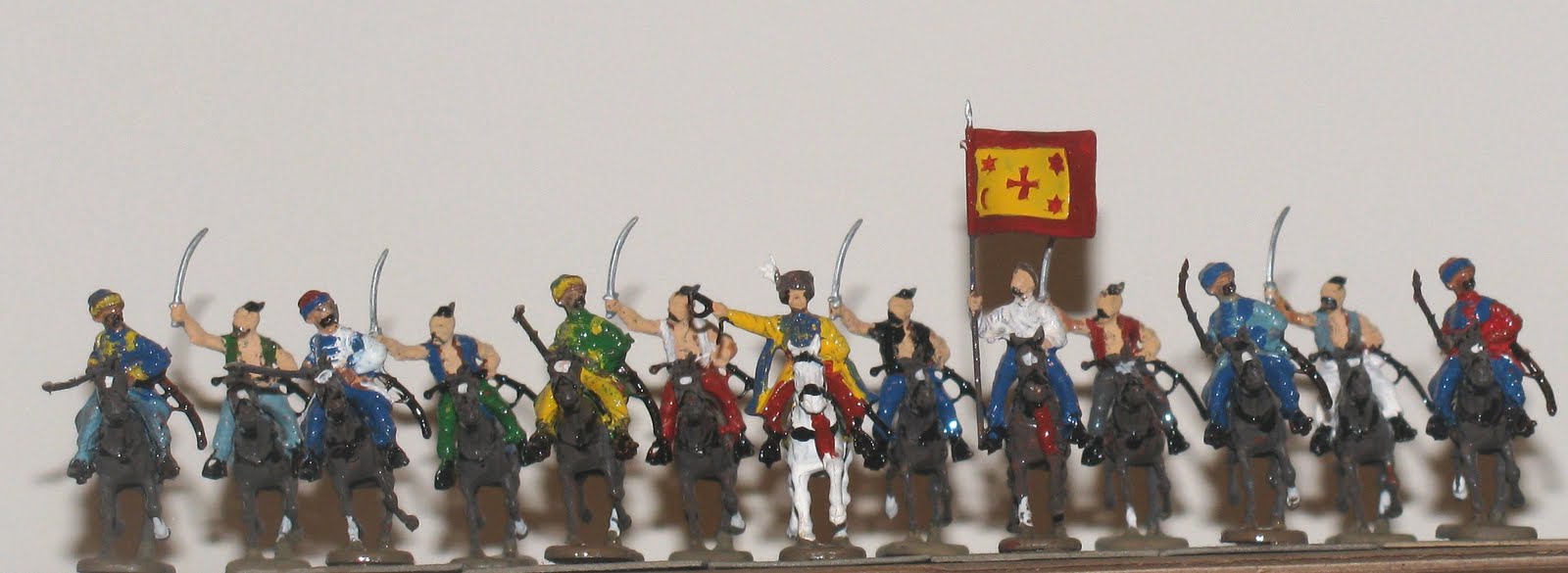
The first picture shows all arms. Then we have some of the horsemen - the typical "Cossack warrior" the world thinks of when they here the word. Then we have one of the drums, used to beat out orders to the men, and finally, infantry armed with muskets and pistols shelter behind a wagon. In that pic you may notice the guy in the light blue shirt reaching up with a "stick" to the top of the wagon.

He is actually lighting a fuse to fire the small cannon positioned on the wagon. Zaporozhian cossacks mounted these cannon on about half of their wagons, making them an early form of mobile artillery post.

On the march, the cossacks would deploy wagons on their flanks and march between them. If faced with a hostile situation, the wagons would close up to form a fortified perimiter, with the cannons ready to be fired, and the men (and women inside.) If the chance for a counter-attack came, some wagons could easily be moved aside to create a gap, or doorway, for the mounted cossacks to ride out on the attack, and then close up behind them, until they were ready to return.

I think they're going to be an interesting bunch to work with, but boy - are they taking forever to paint!

Monday, February 15, 2010

Unit of the Week - Napoleonic Wars French Cuirassiers


Actually, I'm cheating and covering two (almost identical) units - the meat of the French Heavy Cavalry - Cuirassiers (blue jackets above) and Carabiniers (white jackets).

These are the guys that provided the muscle when it was needed. Big men on big horses, kept in reserve until the enemy had been softened up by the artillery and infantry. Then, when the time was right, the massed squadrons of heavy cavalry would be unleashed for the decisive charge that punched a huge hole in the enemy line, and marked the beginning of the end of the battle.

They were effectively the last troops to still wear armor into battle. The use of gunpowder had largely made armor redundant, as bullets could now penetrate the metal, and the additional shattering would make wounds more serious. These heavy cavalry units howeveer still wore a metal breatplate, or cuirass, from which the cuirassiers took their name.

These were the most expensive men in a Napoleonic army, and given the difficulties the French experienced finding suitable horses in the period soon after the Revolution, very "valuable". These weren't troops you just "threw away on a whim." You had to pick the right moment to inject them into a battle.

Because they were big men on big horses, carrying the additional weight of armor, they were also slower moving than the lighter cavalry units such as chasseurs and hussars. They therefore relied on support of these lighter cavalry types to exploit the success of the charge, by pursuing enemy fleeing from the field, while the heavy brigade came to a halt and reformed their ranks.

In the French army, cuirassier and carabinier regiments comprised four squadrons, each of 120 men (6 figures in my army which is scaled down to one figure represents 20 men).

When preparing to attack, a cavalry regiment would deploy in "column of squadrons". Each squadron would deploy in a line, with the squadrons drawn up one behind the other. The distance between each line was critical, as if the first line became disordered during the course of the charge, there had to be sufficient space between it and the following squadron to prevent those behind from crashing into their own men.

When moving forward initially, a regiment would keep at least 40 yards between each squadron's line, enabling it to wheel to form one long line if faced with an attack from the flank. As the speed of the advance increased, the distance would increase to up to 150 yards, allowing more time to come to a halt if required.

French cuirassiers and carabiniers ignored the element of firepower, charging directly with the sword, relying on their size and weight to inflict the damage. (Supporting artillery and possibly also infantry would provide the fire support for a charge).

If the charge did not go well, those supporting infantry would then be required to provide cover for the retreating horsemen, enabling them to regroup, and perhaps prepare for another attempt, back in "friendly territory".